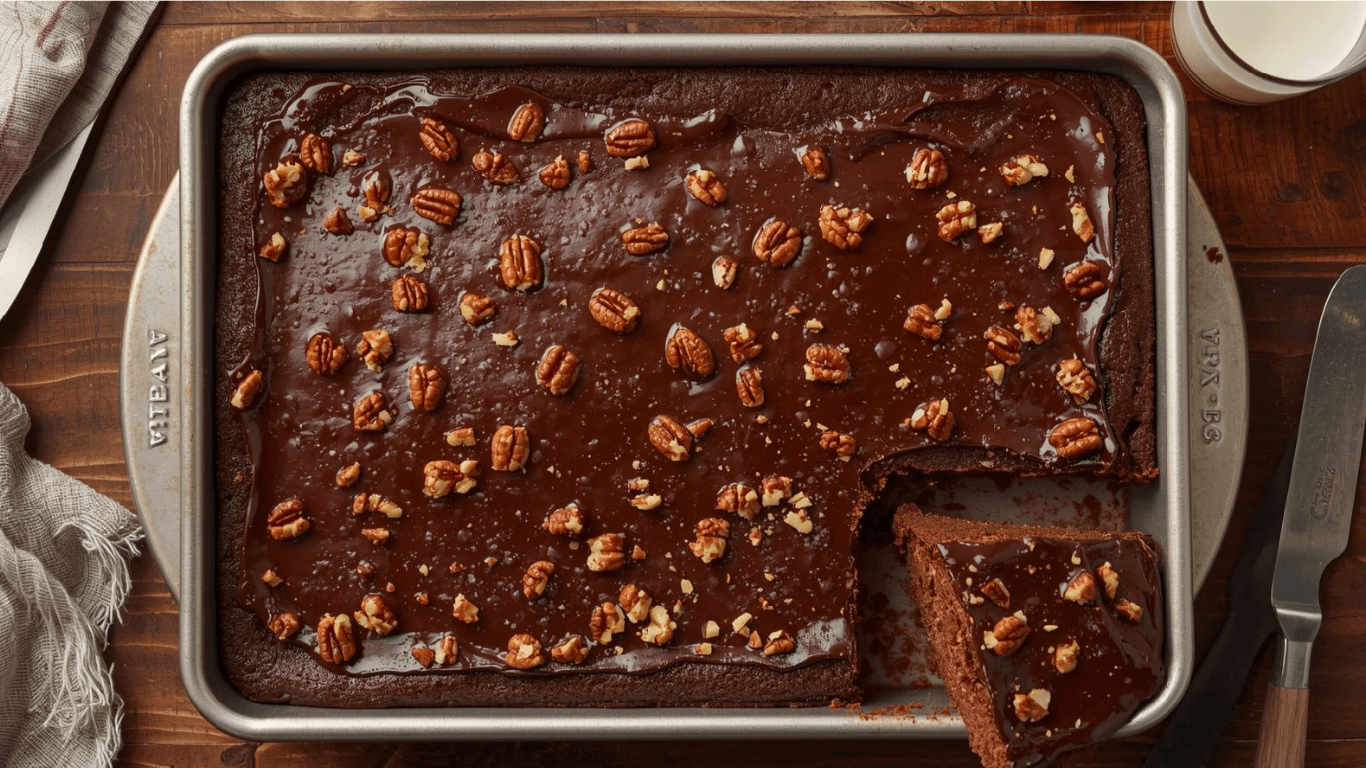
Texas Sheet Cake: How to Create the Famous 2-Step Icing
Why do standard chocolate cakes often feel dry just a day after baking? The answer lies in the hydration method. While most recipes rely on creaming butter and sugar, the Texas Sheet Cake utilizes a rare “boiled batter” technique that gelatinizes the starches before they even hit the oven. This culinary anomaly results in a crumb so moist it practically defies physics.
It is the undisputed champion of large gatherings, yet many modern bakers shy away from it, fearing the pace required for the frosting step. But let’s look at the data: A single 10×15 inch Texas Sheet Cake yields 24 generous servings and requires 40% less active time than a frosted layer cake.
In this guide, we aren’t just baking; we are mastering timing. We will explore how the “2-Step Icing” (poured hot over hot cake) creates a hermetic seal, trapping steam inside the sponge and creating that legendary fudge-like interface. It’s time to make the best chocolate cake of your life.
Ingredients List
To achieve that signature glossy, crackly surface and dense interior, we need specific fats and acids.
The Boiled Base:
- All-Purpose Flour (2 cups / 240g): We need the protein structure here to hold up the heavy liquid content.
- Granulated Sugar (2 cups / 400g): Provides the sweetness and contributes to the crust.
- Unsalted Butter (1 cup / 225g): Cut into cubes for faster melting.
- Filtered Water (1 cup / 240ml): The liquid carrier for the cocoa bloom.
- High-Fat Cocoa Powder (4 tbsp): Using a cocoa with 20-22% fat content (often labeled “Dutch Process”) yields a richer flavor, though natural cocoa is traditional.
- Buttermilk (½ cup / 120ml): The secret weapon. Its acidity tenderizes the gluten and activates the soda.
- Eggs (2 large): Room temperature prevents thermal shock when added to the warm batter.
- Baking Soda (1 tsp) & Pure Vanilla (1 tsp).
The “Hot Pour” Icing:
- Unsalted Butter (½ cup / 113g): The foundation of the fudge.
- Cocoa Powder (2 tbsp): Sifted.
- Whole Milk (6 tbsp): Essential for the emulsion.
- Confectioners’ Sugar (3 ½ cups / 420g): Must be sifted to ensure a glass-like finish.
- Toasted Pecans (1 cup): Roughly chopped. Toasting them releases nut oils that contrast perfectly with the sweet icing.
Timing
Speed is the name of the game. This recipe favors the bold and prepared.
- Mise en Place: 15 minutes
- Bake Time: 20 minutes
- Icing Construction: 5 minutes (Concurrent with baking)
- Total Time: Approx. 40 minutes
- Efficiency Stat: By eliminating cooling time before frosting, this recipe is the fastest “made-from-scratch” celebration cake in the culinary repertoire.
Step-by-Step Instructions
Step 1: The Flavor Bloom
Preheat your oven to 350°F (175°C) and liberally grease a 10×15 jelly roll pan. In a saucepan, bring the butter, water, and cocoa to a rolling boil.
- The Science: Boiling dissolves the sugar crystals completely and “blooms” the cocoa, intensifying the chocolate flavor notes by up to 50% compared to cold mixing.
Step 2: The Thermal Mix
Remove from heat. In a large bowl containing the flour, sugar, salt, and soda, pour the boiling chocolate mixture over the top. Stir gently until just combined.
- Note: The mixture will look thin. This is normal. Do not overmix, or you will develop tough gluten strands.
Step 3: The Acid Shock
Whisk the eggs, buttermilk, and vanilla in a jug. Pour into the warm batter and mix.
- Reaction: The baking soda will start bubbling immediately upon hitting the acidic buttermilk. Get this into the pan fast to capture that aeration!
Step 4: The Flash Bake
Pour into the pan and smooth the corners. Bake for exactly 18–22 minutes.
- Testing: A toothpick should come out clean. Because the cake is thin, it cooks evenly and quickly.
Step 5: The “Hot-on-Hot” Fusion
Critical Timing: Start making the icing when the cake has 5 minutes left in the oven. Melt the butter, cocoa, and milk in a saucepan. Whisk in the powdered sugar and pecans.
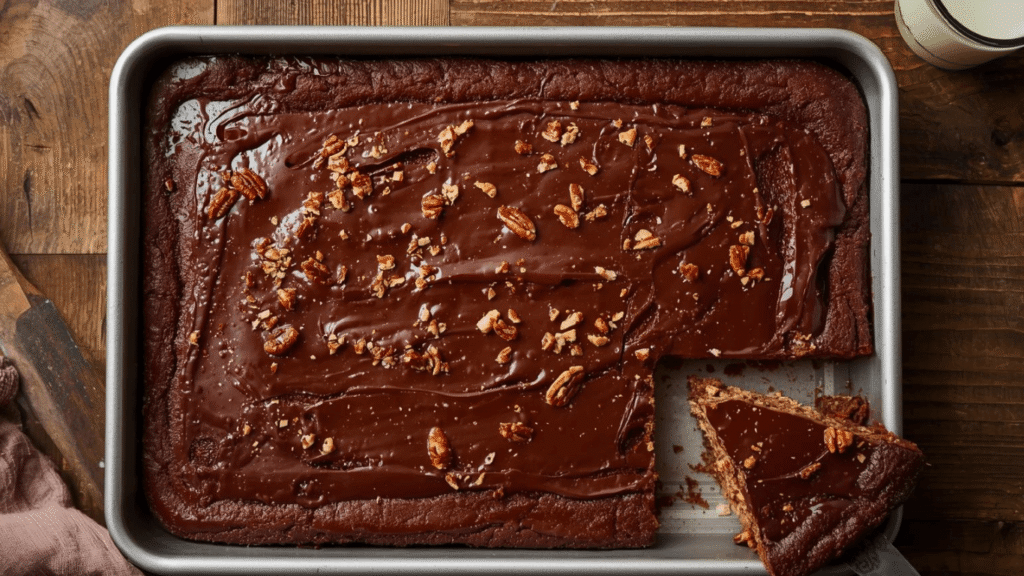
- The Pour: Take the cake out of the oven and immediately pour the hot icing over the surface.
- The Effect: The heat allows the icing to flow like lava, self-leveling into a perfect mirror glaze. As it cools, the interface between the cake and icing fuses into a distinct fudge layer.
Nutritional Information
This is comfort food in its purest form. Breakdown per serving (Yields 24):
| Nutrient | Amount | Insight |
| Calories | 330 kcal | Energy dense due to sugar/fat ratio. |
| Total Fat | 16g | Includes monounsaturated fats from pecans. |
| Saturated Fat | 9g | From real dairy butter. |
| Carbohydrates | 46g | Quick energy release. |
| Sugars | 36g | Primary flavor driver. |
| Protein | 3g | Satiety factor. |
Healthier Alternatives for the Recipe
You can tweak the profile for modern diets without losing the essence.
- Lower Glycemic Index: Swap the granulated sugar for Granulated Monk Fruit (1:1 ratio). The cake texture remains remarkably similar, though the crust may be softer.
- Dairy Reduction: Use Almond Milk and Plant-Based Butter. The boiling method emulsifies plant fats effectively, making this one of the easier cakes to convert to vegan (if using flax eggs).
- Protein Boost: Replace ½ cup of the all-purpose flour with Almond Flour. This adds moisture and boosts the protein content, lowering the overall glycemic load slightly.
Serving Suggestions
The Texas Sheet Cake is versatile in its presentation.
- The “Cold” Service: Unlike most cakes, this one tastes incredible straight from the fridge. The icing snaps like a candy bar, and the dense cake feels like a truffle.
- A la Mode: Serve warm with Cinnamon Ice Cream. The spice notes highlight the chocolate bloom beautifully.
- Coffee Pairing: The sweetness of this cake demands a bitter contrast. Serve with a dark roast espresso or black coffee to cleanse the palate between bites.
Common Mistakes to Avoid
- Waiting to Ice:
- The Error: Letting the cake cool for even 10 minutes.
- The Result: The icing won’t spread. You’ll have to spread it with a knife, tearing the tender surface of the cake.
- The Mantra: Hot icing, hot cake.
- Omiting the Salt:
- The Error: Forgetting salt in the icing.
- The Result: A cloying, one-dimensional sweetness. Add a pinch of sea salt to the icing to pop the chocolate flavor.
- Using a Deep Pan:
- The Error: Baking in a 9×13 casserole dish.
- The Result: The center stays raw while the edges burn. This batter is designed for shallow, fast baking.
Storing Tips for the Recipe
This cake defies the “stale by day two” rule.
- Room Temp: Covered, it improves on Day 2 as the icing moisture migrates further into the sponge. Good for 4 days.
- Freeze It: Cut into squares, freeze on a tray, then bag them. They thaw in 15 minutes and taste freshly baked.
- Travel: This is the ultimate “Car Cake.” Leave it in the pan, cover with foil, and it can survive a bumpy car ride without sliding apart like layer cakes.
Conclusion
The Texas Sheet Cake is a masterclass in efficiency and satisfaction. By understanding the thermodynamics of the “boil and pour” method, you unlock a dessert that is moist, rich, and crowd-pleasing. It proves that sometimes, the old ways—and the simple steps—really are the best.
Have you tried the hot-pour technique? Tell us how it went! Share your photos, rate the recipe below, and subscribe for more science-backed baking tutorials.
FAQs
Q: Can I use walnuts instead of pecans? A: Absolutely. Walnuts are a classic substitute. For a nut-free version, try toasted pumpkin seeds or simply omit them entirely for a smooth finish.
Q: Why is my icing runny? A: You likely added too much milk or didn’t measure the sugar correctly. The icing should be the consistency of thick honey when hot. If it’s too thin, whisk in another ¼ cup of powdered sugar.
Q: Can I half this recipe? A: Yes! Bake it in a standard 9×13 quarter sheet pan. Check the cake at 15 minutes as it may bake slightly faster due to lower thermal mass.
Q: Is it safe to pour boiling icing? A: Yes, but be careful! Pour slowly and close to the cake surface to avoid splatter. The heat is necessary to sterilize the surface and create the seal.
Your feedback helps other cooks succeed. Rate this recipe!
Icing Technique is Key
The cake itself is wonderfully simple and chocolatey. The real make-or-break step is the icing. I learned the hard way that you must pour it on the cake the second it comes out of the oven. I got distracted and waited 5 minutes, and my icing didn’t soak in properly, leaving a thicker, gooey layer on top instead of that perfect fudgy seal. Follow the timing exactly! Once I got that right on my second attempt, it was a flawless, nostalgic Texas Sheet Cake.
![How To Bake A Perfect [tres leches cake] In 7 Easy Steps](https://monetizegrid.com/wp-content/uploads/2026/02/Untitled-design-2026-02-02T112201.379-768x432.webp)